About
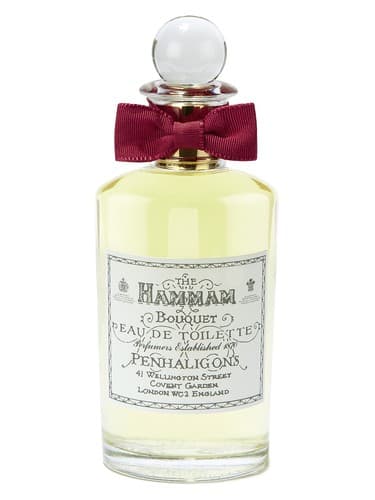
Penhaligon's introduced Hammam Bouquet in 1872, a Oriental Woody men's fragrance crafted by William Penhaligon. The composition opens with lavender, bergamot. A heart of jasmine, cedar, orris root, rose follows. The dry down features musk, sandalwood, amber.
Fragrance Notes
Middle Notes
Heart of the fragrance (2-4 hrs)
Base Notes
Dry down (4+ hrs)
Accords
powdery
woody
rose
lavender
musky
iris
floral
aromatic
white floral
amber
When to Wear
Best Seasons
Time of Day
☀️Day19%
🌙Night17%
Where to Buy
This site contains affiliate links. As an Amazon Associate and partner of other retailers, we earn from qualifying purchases at no extra cost to you.
Community Review
A Victorian Gentleman's Steam Bath, Bottled — Hammam Bouquet by Penhaligon's
The Verdict
Hammam Bouquet has been in continuous production since 1872, making it one of the oldest commercially available fragrances in the world. Created by William Penhaligon himself and named for the Turkish steam baths then fashionable on London's Jermyn Street, it is a fragrance built on the thinking of its era: florals at the front, woods and animalics at the back, herbals in the heart to connect them. That it still exists at all is a kind of miracle; that it still smells unmistakably Victorian is either its greatest virtue or its most significant barrier, depending on your sensibilities.
With 38% loving and 41% liking it across 524 votes, Hammam Bouquet earns genuine appreciation — particularly from those who wear it for what it is rather than what they expected it to be.
What It Smells Like
The opening is more legible than most Victorian fragrances: Bergamot provides citrus brightness, and Lavender gives it a clean, herbal freshness that reads as relatively modern. It is the most accessible phase of the fragrance — bracing, slightly barbershop in character, and clear in intent.
The heart is where the Victorian identity asserts itself. Rose, Orris Root, Jasmine, and Cedar come together in a floral accord that is deep, romantic, and slightly dusty — not a fresh rose in a vase but a pressed rose in an old letter. The orris in particular brings a powdery iris quality that was a hallmark of late 19th-century masculines and is essentially absent from contemporary men's fragrance. The combination leans feminine to modern noses, but Basenotes reviewers consistently note that "the rose is suitable for a man — deep and romantic rather than sweet."
The base is the fragrance's most characteristically Victorian element. Musk, Sandalwood, and Amber build a warm, resinous foundation with what multiple reviewers describe as a quiet animalic quality — a slightly skunky or urine-like sharpness that emulated male sweat and was considered alluring rather than objectionable in the 19th century. This is "the skank element," as one Basenotes reviewer diplomatically calls it, and it is the point at which the fragrance most sharply divides its audience. Fans find it "intriguing and world-weary"; detractors call it "stuffy" or worse.
One of the most evocative descriptions comes from a long-term wearer: "It's just like an opening door to the classical Victorian era where masculinity and dandyism are the main principles of every gentleman."
When to Wear It
Fall and winter, with a surprisingly even day/night split (19% day, 17% night) that reflects its versatility within formal and cool-weather contexts. This is a fragrance for the deliberate moment: a formal dinner, an evening event, a significant occasion. It would feel out of register in casual settings, and warm weather would amplify its animalic base past the point of comfort.
The suitability for winter evening events in particular aligns with its origins — the 19th century Turkish bath as a social refuge from London cold.
Longevity & Projection
Good longevity, moderate projection. Expect six to ten hours of wear with the resinous base providing an extended close-to-skin trail. Projection is refined rather than assertive — the fragrance was not designed to announce itself across a room, but rather to be detected by those in conversation distance. This matches its occasion profile: formal, intimate, considered.
The Community Says
Hammam Bouquet generates the most sharply divided language in its category. Enthusiasts call it "totally unique," "a perfect companion for formal occasions," and note that "sometimes I like wearing fragrances which evoke another time — Hammam Bouquet can inject a surreal note into an otherwise humdrum day." The 1872 provenance is cited with genuine reverence.
The detractors are equally specific: "Mortuary-like gothic musky rose," "stiff and archaic," "appropriate only for 19th-century reenactments." One reviewer noted simply that "it does not smell bad or ugly — it's just very old fashioned, old fashioned in a stuffy odd way." These are not unreasonable reactions to a fragrance that genuinely predates modern perfumery conventions by 150 years.
The consensus that emerges from fragrance forum discussions: sample before buying, and approach it as a historical artifact that happens to be wearable rather than as a modern fragrance that happens to be old.
Who Should Buy This
Hammam Bouquet is for the fragrance enthusiast who is curious about what masculine perfumery looked like before it was shaped by modern conventions — before synthetic musks, before clean woody accords, before the category was defined by freshness and projection. If you enjoy vintage Guerlain masculines, Acqua di Parma's more classical compositions, or the Floris heritage line, Hammam Bouquet deserves your attention.
Skip it if animalic musks, heavy powder, or deeply romantic rose notes are reliably unwelcome on your skin or in your preferences.
The Bottom Line
An extraordinary piece of living fragrance history that has survived 150 years of fashion changes precisely because it was never designed to be fashionable. Whether it belongs in your collection depends entirely on whether you find historical authenticity compelling. Those who do will find it genuinely irreplaceable — there is nothing remotely like it being made today.
Consensus Rating
7.9/10
Community Sentiment
mixedSources Analyzed
9 community posts (4 Reddit) (5 forum)
This review is based on analysis of 9 community discussions. Individual experiences may vary.