About
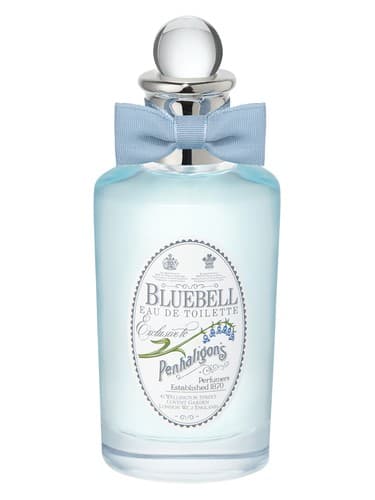
Penhaligon's introduced Bluebell in 1978, a Floral Green women's fragrance crafted by Michael Pickthall. The composition opens with citruses. The heart features jasmine, hyacinth, rose, lily-of-the-valley, cyclamen. A foundation of galbanum, cloves, cinnamon anchors the dry down.
Fragrance Notes
Accords
green
floral
white floral
warm spicy
fresh spicy
rose
fresh
When to Wear
Best Seasons
Time of Day
☀️Day32%
🌙Night5%
Where to Buy
This site contains affiliate links. As an Amazon Associate and partner of other retailers, we earn from qualifying purchases at no extra cost to you.
Community Review
An English Woodland in a Glass Bottle — Bluebell by Penhaligon's
The Verdict
Penhaligon's Bluebell has been the definitive bluebell fragrance since Michael Pickthall created it in 1978, and it remains one of the British house's longest-running bestsellers. Its celebrity pedigree is remarkable: Margaret Thatcher, Princess Diana, and Kate Moss have all been associated with it, and it appears in Dodie Smith's novel "I Capture the Castle," a reference that has reportedly driven bottle sales for decades.
None of that history prevents Bluebell from being one of the most polarizing fragrances in Penhaligon's catalog. The Fragrantica community is split, with 26 percent loving it, 38 percent liking it, and a full 32 percent actively disliking it. On Basenotes, opinions range from "the freshest scent in the world, like being on your knees in damp spring to sniff the very first bulb that came up" to "horrifying synthetic floral at its worst -- simply abominable." There is almost no middle ground with this fragrance. You either smell an enchanted English woodland or you smell chemical cleaning products.
What It Smells Like
The opening presents a burst of green citruses that establishes the composition's sharp, verdant character from the first spray. Within minutes, the heart flowers emerge: hyacinth is the dominant note, supported by lily-of-the-valley, rose, cyclamen, and jasmine. The hyacinth is rendered with an aggressive realism that divides noses -- fans describe it as capturing "not just that hyacinth-like sweetness, but also an earthy and wet sense so reminiscent of woodlands and misty, dew-soaked mornings."
What makes Bluebell distinctive is the earthy, almost soil-like quality underneath the florals. Vintage bottles contain what one reviewer identified as "a hint of soil tincture," and even the current formulation retains an impression of damp earth and flower bulbs. The galbanum in the base reinforces the green character throughout.
The dry down brings unexpected warmth from cloves and cinnamon, which some Penhaligon's fans recognize as the house's signature approach to constructing a soil accord. The clove note is a particular flashpoint -- on certain skin chemistries, it can overwhelm the florals entirely and transform the fragrance into what one reviewer described as "a clove bomb."
When to Wear It
Spring is the obvious and correct answer. This is a fragrance that evokes the specific moment when the first bulbs push through thawing earth, and wearing it in any other season misses the point. Summer works for those who enjoy green florals in warm weather, as one reviewer found it "powerful yet very clean smelling" in the heat.
Fall and winter are poor choices -- the light, green character has nothing to offer against cold air, and the weak projection would make it essentially invisible. Daytime is strongly preferred, and the setting should ideally be outdoors or in well-ventilated spaces where the fragrance can breathe.
Longevity & Projection
Longevity is Bluebell's most consistent weakness. Many reviewers report it vanishes within an hour or two, becoming a faint skin scent that only the wearer can detect. One Fragrantica user noted that "though it goes on strong it doesn't last."
However, some dissenting voices report surprisingly good performance. One Basenotes reviewer found it "performs like an eau de parfum" with moderate sillage lasting 4 to 5 hours before settling into a skin scent for another 4 to 5 hours. A decant seller who handled the fragrance regularly reported smelling like Bluebell "for days afterwards," praising its sillage and longevity as "amazing."
The wide performance range suggests significant variation between bottles, formulations, and skin types. Application to clothing and hair may help compensate for those who experience rapid fadeout. Three to four sprays is a reasonable starting point, with reapplication likely necessary.
The Community Says
Bluebell inspires some of the most poetic descriptions in the fragrance community. One Basenotes devotee wrote: "Bluebell really captures what this fragrance house is all about -- unashamedly English, in the most charming, individual and nostalgic way." Another described it as "a fairy scent, the scent of an enchanted woodland place." Fans praise "their unapologetic stemmy, sharp greenness that opens the senses, the dewy floral splendor, and their spicy, cinnamic undertones."
The negative camp is equally vivid. One Basenotes reviewer compared the scent to "that fluorescent light of some public bathrooms." Another dismissed the entire concept: "Bluebells have no smell, so they have represented a chemical dump instead -- really quite nasty." A particularly thoughtful mixed review noted that it was easy to "dismiss this scent as screechy, synthetic and offensive" at first, but after several wearings, the reviewer came to appreciate how "Bluebell replicates a very realistic hyacinth flower."
Reformulation concerns loom large, with some long-time fans suspecting the formula was softened roughly a decade ago, "taking all the edges off the original, making it more acceptable to many women" but leaving it "more bland."
Who Should Buy This
Bluebell is for those who love naturalistic green florals and want a fragrance that smells like a specific place and time rather than a generic pretty scent. If you have fond associations with English gardens, hyacinths, or the wet-earth smell of early spring, this is one of the few fragrances that genuinely attempts to capture that experience. Fans of vintage green fragrances like Chanel No. 19, Cristalle, or Estee Lauder Aliage will find a kindred spirit.
Skip it if you expect modern longevity and projection, if sharp green notes or cloves give you headaches, or if you associate heavy floral compositions with cleaning products. At Penhaligon's pricing, the weak performance is a legitimate concern. Sampling is essential -- the range of reactions to Bluebell is too extreme to risk a blind buy.
The Bottom Line
Penhaligon's Bluebell is a fragrance that exists outside of trends. It was not designed to please everyone in 1978, and it does not please everyone now. What it does, when it works, is transport you to a specific patch of damp English woodland in early April, with all the earthy, green, dewy beauty that entails. It is a cult classic for good reason, but the cult is self-selecting. Either the magic lands for you or it does not, and no amount of celebrity endorsement or literary pedigree will bridge that gap.
Consensus Rating
7/10
Community Sentiment
mixedSources Analyzed
7 community posts (5 Reddit) (2 forum)
This review is based on analysis of 7 community discussions. Individual experiences may vary.