About
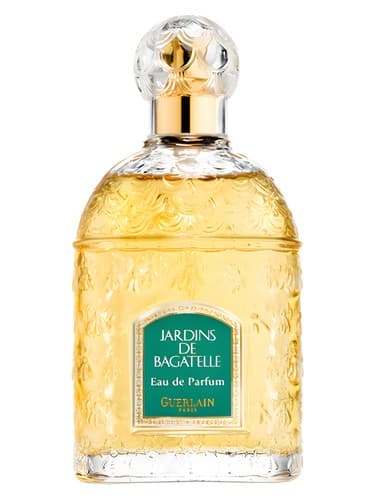
Guerlain introduced Jardins de Bagatelle in 1983, a Floral women's fragrance crafted by Jean-Paul Guerlain. The composition opens with jasmine, bergamot, lemon, violet, aldehydes. Orange blossom, narcissus, gardenia, ylang-ylang, tuberose, rose, lily-of-the-valley, magnolia, orchid form the heart. A foundation of vetiver, musk, neroli, patchouli, cedar anchors the dry down.
Fragrance Notes
Accords
white floral
yellow floral
citrus
floral
fresh
tuberose
green
woody
aldehydic
When to Wear
Best Seasons
Time of Day
☀️Day27%
🌙Night10%
Where to Buy
This site contains affiliate links. As an Amazon Associate and partner of other retailers, we earn from qualifying purchases at no extra cost to you.
Community Review
The Grande Dame of White Florals — Jardins de Bagatelle by Guerlain
The Verdict
Jardins de Bagatelle is Jean-Paul Guerlain's love letter to the famous rose garden on the edge of the Bois de Boulogne in Paris -- a garden that has cultivated over 700 species of roses since the 18th century. Launched in 1983 at the height of the power-floral era, it stands alongside Giorgio Beverly Hills and Poison as one of the defining white florals of its decade. But unlike those more aggressive contemporaries, Jardins de Bagatelle has aged with considerably more grace. With a 3.98 average from 1,708 votes, it maintains a devoted following four decades after its debut.
What It Smells Like
This is a fragrance of staggering floral complexity. The opening hits with Jasmine, Bergamot, Lemon, Violet, and Aldehydes -- the aldehydes providing that classic "sparkling" quality found in mid-century French perfumery. It reads golden, bright, and immediately opulent.
The heart is where things get serious. Orange Blossom, Narcissus, Gardenia, Ylang-Ylang, Tuberose, Rose, Lily-of-the-Valley, Magnolia, Orchid -- nine florals creating what one Parfumo reviewer described as "a sonata with three very distinct movements." This is not a single-note soliflore but a full orchestral arrangement. The tuberose and gardenia provide creamy richness, the rose adds classic structure, and the ylang-ylang contributes a slightly tropical sweetness.
The base resolves into Vetiver, Musk, Neroli, Patchouli, and Cedar -- bringing earthiness and staying power to what could otherwise be overwhelming sweetness. One Basenotes reviewer noted that "this darker chypre-like layer stays with me for hours, while the memory of the florals lightly lingers behind."
The overall effect has been described as "a floral bouquet with a very buttery honey feeling" and "a bouquet of flowers in a very warm summer's afternoon." It is unabashedly feminine, unabashedly grand, and unapologetic about filling a room.
When to Wear It
Spring through early fall, with spring being the perfect season for this garden-inspired composition. It works for romantic occasions, garden parties, and any event where you want to make an entrance. Several reviewers find it versatile enough for daily wear, but others caution that the sillage can be powerful -- a single spray may be all you need.
The community is emphatic: this is not a winter fragrance. The floral bouquet needs warmth to bloom properly on skin.
Longevity & Projection
The original formulation was legendary for its projection. The Black Narcissus blog claimed it "has perhaps the best sillage I know in all perfumery." Even in current formulations, Jardins de Bagatelle is not a shy fragrance. Expect moderate-to-strong projection for several hours before it settles closer to the skin.
Longevity depends heavily on concentration. The EDT runs about 4-6 hours; the EDP (which the community generally prefers) lasts 6-8 hours and is described as "not stronger but more lush -- a richer white floral experience." The newer 2021 EDP formulation receives praise as "breathtakingly beautiful, creamy and soft" though opinions differ on whether it captures the magic of the original.
The Community Says
Jardins de Bagatelle inspires genuine passion. On Basenotes, it is called "the prettiest and most noble of the big 1980s florals." One partner of a wearer declared "this is how a woman is supposed to smell," and it regularly appears in threads about timeless, unforgettable fragrances. Supporters insist it is not dated: "I would not call Jardins too 80s, I would call it timeless."
The reformulation conversation dominates every discussion, however. The vintage version is praised as "the real bomb, both powerful and sophisticated, full of nuances and grace." The modern formula is described as "similar but harsher and less nuanced." The Scented Salamander blog was particularly harsh on the circa-2014 reformulation, calling it "technically being a dupe of itself." If you can find vintage bottles (bell jar or early spray versions), the community strongly recommends them.
Detractors find the florals overwhelming. Some report headaches, sneezing, and queasiness -- not uncommon reactions to concentrated white florals, especially tuberose. Others find it too soapy or too aldehydic for modern tastes. The general advice is "tiny amounts are paramount with these perfumes."
Who Should Buy This
If you love white florals -- if tuberose, gardenia, and jasmine are your vocabulary rather than your vocabulary limit -- Jardins de Bagatelle is essential sampling. It is one of the great achievements of French perfumery, and Jean-Paul Guerlain's craftsmanship is evident in every transition and accord. The EDP concentration is the recommended entry point.
Skip it if strong florals give you headaches, if aldehydes read as "old lady" to your nose, or if you prefer modern minimalist fragrances. Also skip it if you need something that flies under the radar -- even in its current formulation, Jardins de Bagatelle does not do subtle.
The Bottom Line
Four decades later, Jardins de Bagatelle remains one of the definitive white floral compositions in perfumery. The vintage version was transcendent; the modern version is still very good, if not quite the masterpiece it once was. In an era of clean-girl minimalism and molecule fragrances, wearing Jardins de Bagatelle is a statement -- one that says you believe perfume should be an event, not a whisper.
Consensus Rating
8/10
Community Sentiment
positiveSources Analyzed
9 community posts (3 Reddit) (6 forum)
This review is based on analysis of 9 community discussions. Individual experiences may vary.