About
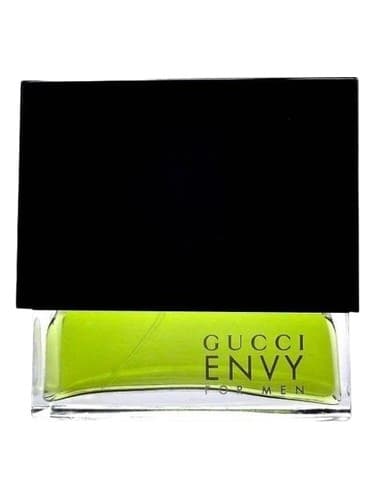
Gucci introduced Envy for Men in 1998, a Oriental Woody men's fragrance crafted by Daniela Andrier. The composition opens with lavender, mahogany, ginger, cardamom, coriander, mandarin orange, pepper. Carnation, jasmine, sandalwood, cedar, rose form the heart. A foundation of vetiver, musk, patchouli, amber, incense, vanilla, tobacco, leather anchors the dry down.
Fragrance Notes
Accords
woody
warm spicy
aromatic
fresh spicy
amber
smoky
powdery
balsamic
tobacco
lavender
When to Wear
Best Seasons
Time of Day
☀️Day16%
🌙Night22%
Where to Buy
This site contains affiliate links. As an Amazon Associate and partner of other retailers, we earn from qualifying purchases at no extra cost to you.
Community Review
The Discontinued Gem That Became Its Own Legend — Envy for Men by Gucci
The Verdict
Gucci Envy for Men was released in 1998 by perfumer Daniela Andrier. It is now discontinued, has been for years, and its reputation has only grown in its absence. What was once a moderately successful designer masculine that gradually drifted to discount shelves before its discontinuation has become, through the compound interest of community nostalgia and YouTube fragrance coverage, one of the most discussed and sought-after lost masculines in the collector market.
The community is thoughtful enough to acknowledge that this is partly a discontinuation phenomenon. One Basenotes reviewer noted that "Envy has never been a big thing while still in production" and that the hype began substantially after its discontinuation — a pattern that repeats itself with several cult classics and tells us something about how fragrance community memory operates. The same reviewer was careful to note this doesn't make the fragrance bad, just that the legend deserves some calibration against reality.
The calibrated reality is still impressive. With 2,829 votes on Fragrantica and a 4.45/5 average — 60% love, 32% like, barely 8% neutral or negative — Envy for Men is not a fragrance propped up purely by nostalgia. The composition itself, built around a bold, spicy ginger-incense-lavender opening with a rich woody-oriental base, earns its standing. At its best, it represents everything the late 90s masculine oriental genre could do — and the note complexity (20 notes ranging from cardamom and coriander through incense, tobacco, leather, and vanilla) is genuinely unusual for a designer release of any era.
What It Smells Like
The opening is immediate and authoritative. Lavender, Mahogany, Ginger, Cardamom, Coriander, and Mandarin Orange all arrive in the first phase, and the combination creates something that Black Narcissus described as "a very heavy ginger over patchouli, all backed with a fully masculine yet timelessly modern structure." The ginger is the dominant character — not the sweet ginger of many oriental fragrances, but a sharp, almost medicinal ginger that has an edge to it. It sits over the lavender and mandarin orange, which function as structural elements that soften the spice without sweetening it.
Incense begins to emerge in the transition from top to heart, adding a smoky depth that pushes the composition toward the oriental category. The heart notes — Carnation, Jasmine, Sandalwood, Cedar, and Rose — are unusual for a masculine of this era: carnation and rose in a men's fragrance was rare in 1998, and the combination creates a slightly powdery, slightly sweet floral dimension that Envy manages to make feel masculine rather than gender-ambiguous. The Black Narcissus called this "quite 'Tom Ford' in character" even before Tom Ford had established his signature style, which in retrospect seems prescient.
The drydown into Vetiver, Patchouli, Amber, Vanilla, Tobacco, and Leather is where the composition settles into its long-lasting oriental base. This is not the clean, modern vanilla-amber of contemporary masculines — it's darker, more complex, with the vetiver and patchouli adding a slightly earthy quality that grounds the sweetness. The tobacco and leather are present but not dominant. The overall effect at the late drydown stage is a warm, complex oriental that feels genuinely different from current designer releases.
When to Wear It
Fall and winter, unambiguously. The spiced oriental character needs coolness to read at its best; in heat, the ginger amplifies unpleasantly and the composition loses the balance that makes it work. Community vote data shows evening preference (22% night vs 16% day), which reflects the composition's formal weight — it has presence and projection, and that presence is better suited to occasions where it can be appreciated rather than workplaces where it might overwhelm.
Evening events, dinners, special occasions, and cold-weather nights out are the ideal context. Office wear is possible in winter with restrained application, but this is not an office-first fragrance.
Longevity & Projection
Performance is one of Envy's most lauded qualities — this is a fragrance that performs excellently for an EDT, with community reports consistently noting 8-12 hours with strong opening projection. The spiced oriental base materials are inherently tenacious, and the vintage formulation does not seem to have suffered the performance reductions that affect some fragrances aging in bottle.
The projection in the first 2-3 hours is significant. This is a fragrance that announces itself and maintains presence. After that initial phase it settles into a more intimate sillage while remaining detectable. Two to three sprays is sufficient — more is excessive.
The Community Says
The community reaction covers a spectrum from devotion to measured skepticism, and the honest account includes both.
The enthusiasts describe it as "an emerald green jewel of a fragrance" and a fragrance that "remains a benchmark for what a truly great oriental-woody can be." Multiple Basenotes reviewers consider it superior to most current designer masculines in complexity and character. One wrote that it "represents an era when mainstream releases were willing to be daring, complex, and unapologetically bold" — a characterization that is difficult to argue with given the current mainstream landscape.
The skeptics note that the hype machine around discontinued fragrances is well-documented, and that Envy benefited substantially from influencer coverage after its discontinuation: "The almighty and insurmountable reputation of Gucci Envy for Men, earned from the hype given to it by YouTube and Instagram influencers, can hardly be parsed from the fragrance itself." This is a legitimate point. The fragrance is genuinely good. Whether it's worth $200-400+ on secondary markets is a separate question.
For comparison purposes, the community frequently mentions YSL La Nuit de L'Homme (lavender-cedar-cardamom with similar masculine warmth) and various Tom Ford orientals as contemporaneous alternatives at different price points.
Who Should Buy This
For serious masculine oriental collectors, enthusiasts building a comprehensive library of influential discontinued fragrances, and buyers who specifically want what Envy provides — that combination of sharp ginger, incense, and woody-oriental depth — and can't find it adequately in current releases.
Skip it if you're working from a budget, if you need to sample before committing and find reliable decants difficult to source, or if you're primarily attracted to the reputation rather than the scent profile. Buying blind at secondary market prices for a fragrance whose character may or may not match your preferences is a significant financial risk.
Decant sourcing or sampling before any full-bottle purchase is the strongest possible recommendation the community makes about this fragrance.
The Bottom Line
Gucci Envy for Men is a genuinely excellent fragrance that has become partially a myth. The composition earns respect on its own terms: a bold, complex, spiced oriental from 1998 that smells more timeless than most of what surrounds it. The discontinued cult status is partly deserved and partly manufactured by the mechanics of fragrance community memory. What it is: one of the better designer masculines of the late 90s, now priced as a collector's item rather than a daily wear option. If you can sample it first, do. If you love it, decide whether the secondary market price reflects value or nostalgia.
Consensus Rating
9.2/10
Community Sentiment
positiveSources Analyzed
13 community posts (6 Reddit) (7 forum)
This review is based on analysis of 13 community discussions. Individual experiences may vary.