About
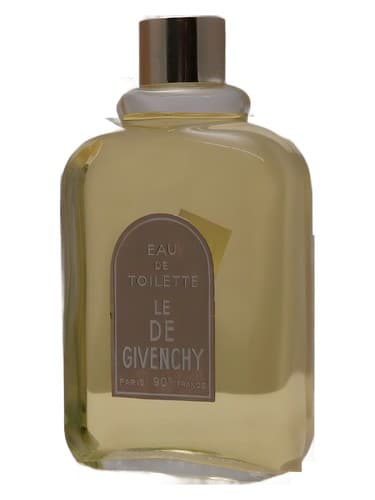
Le De Givenchy is a Woody Floral Musk women's fragrance from Givenchy, launched in 1957. The composition opens with coriander, bergamot, mandarin orange, tarragon, brazilian rosewood. The middle unfolds with carnation, jasmine, ylang-ylang, orris root, rose, lily-of-the-valley, lilac. The base resolves into musk, sandalwood, guaiac wood, oakmoss, amber.
Fragrance Notes
Top Notes
First impression (15-30 min)
Middle Notes
Heart of the fragrance (2-4 hrs)
Base Notes
Dry down (4+ hrs)
Accords
floral
white floral
woody
aromatic
fresh
powdery
iris
yellow floral
earthy
green
When to Wear
Best Seasons
Time of Day
☀️Day25%
🌙Night14%
Where to Buy
This site contains affiliate links. As an Amazon Associate and partner of other retailers, we earn from qualifying purchases at no extra cost to you.
Community Review
A quietly indolic, beautifully balanced vintage floral with herbal top notes and an oakmoss-grounded base. Classic Givenchy elegance for cool weather.
The Verdict
Le De Givenchy is Hubert de Givenchy's quieter masterpiece — the one that never chased fame the way L'Interdit did, yet arguably holds more fascination for those who find it. Launched in 1957, the same year as L'Interdit, it was created for the inner circle: haute couture clients, personal friends, a world of discretion. Today it occupies a particular place in perfumery history as a floral that refuses to be simple about it. This is not a bottle you pick up at duty free. Finding it is part of the experience, and wearing it rewards patience.
What It Smells Like
The opening is immediately of its era — Bergamot and Mandarin Orange brighten the top, but it's the herbal notes that tell you something unusual is happening. Tarragon and Coriander are rare choices, and reviewers consistently flag them as the detail that gives Le De its spine. As one Fragrantica member put it, these two notes are "used artfully" in a way that modern perfumery rarely attempts.
The floral heart is generous without being loud. Jasmine, Ylang-Ylang, Rose, Carnation, Orris Root, Lily-of-the-Valley, and Lilac arrive in a layered progression, each contributing without dominating. Here is where the fragrance reveals its indolic character — the jasmine in particular carries a warmth that some will read as animalic, others as simply true to the flower. It is not dirty in the way a civet-heavy oriental can be; it is more like the honest, slightly heady smell of white flowers in a warm room.
The dry-down leans into Sandalwood, Guaiac Wood, Oakmoss, and Amber, with Musk rounding everything out. The oakmoss is worth noting: in older formulations it was present and grounding; modern reissues, particularly the 2007 Les Mythiques re-edition, had to reduce or eliminate it to comply with IFRA restrictions. If you find a vintage bottle, that base tells a different story than anything on shelves today.
When to Wear It
Spring and fall are the natural seasons for this one. It projects cleanly on cool skin — the herbal top notes breathe better when there's a chill in the air, and the mossy base wraps around you more comfortably when you're not competing with heat and humidity. The community's preference runs decisively toward daytime, which makes sense: there's an alertness to the opening that suits a workday or afternoon out. That said, anyone familiar with vintage florals will recognise this as an evening-appropriate scent depending on context.
Longevity & Projection
Modern reformulations and remaining stock vary considerably. Vintage bottles — particularly the pure parfum — can last through the day with real presence; reviewers have reported that even dilute formulations still linger on fabric through the evening. Spray application on pulse points works well, but this is a fragrance that rewards dabbing on warm skin as well. Expect moderate sillage that stays within arm's reach rather than announcing itself across a room, which suits its character perfectly.
The Community Says
The Fragrantica consensus on Le De Givenchy is admiration tempered by difficulty. One longtime wearer who first encountered it at fourteen and still reaches for it in their sixties describes it as the archetype of a green floral that moves from light to dense and earthy. Another notes that "the notes play well together, nothing jumps out to announce itself" — which is, of course, the point. The indolic angle does prompt warnings from more candid reviewers: if jasmine's natural warmth bothers you, be aware this version goes there. But the reception from those who are comfortable with vintage florals tilts strongly positive, with many lamenting that it has been "overtaken by modern Givenchy scents" and deserves considerably more attention.
There is also a recurring theme of treasure: one reviewer described acquiring vintage miniatures alongside L'Interdit from an estate sale, certain the sellers had no idea what they were parting with.
Who Should Buy This
Vintage floral enthusiasts who want to understand what the post-war golden age of French perfumery smelled like. People who appreciate the understated formality of a fougère or a chypre and want something similar in a white floral register. Anyone whose reference points are Chanel No. 5 or Guerlain L'Heure Bleue will feel at home here. On the other end, if you find indolic jasmine uncomfortable, or if you need a fragrance that projects confidently in a large space, this will frustrate you.
The Bottom Line
Le De Givenchy is a lesson in restraint and class. It wears close to the skin, it speaks quietly, and it rewards the people around you more than it announces itself. The reformulation gap is real — if you can locate a vintage formulation, the oakmoss base and more generous use of natural materials make a meaningful difference. But even in its current form, this is a fragrance with genuine character and a backstory that modern releases rarely match. Worth hunting down.
Consensus Rating
8.2/10
Community Sentiment
positiveSources Analyzed
4 community posts (3 Reddit) (1 forum)
This review is based on analysis of 4 community discussions. Individual experiences may vary.