About
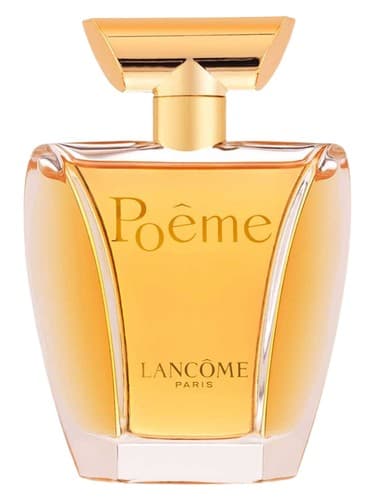
Lancôme introduced Poeme in 1995, a Floral women's fragrance crafted by Jacques Cavallier Belletrud. The composition opens with narcissus, bergamot, mandarin orange, peach, black currant, plum, green notes, blue poppy, datura. Jasmine, orange blossom, ylang-ylang, tuberose, vanilla, freesia, heliotrope, rose, leather, mimosa form the heart. The dry down features musk, cedar, amber, tonka bean.
Fragrance Notes
Top Notes
First impression (15-30 min)
Middle Notes
Heart of the fragrance (2-4 hrs)
Base Notes
Dry down (4+ hrs)
Accords
yellow floral
white floral
powdery
sweet
floral
vanilla
fruity
green
tuberose
animalic
When to Wear
Best Seasons
Time of Day
☀️Day18%
🌙Night20%
Where to Buy
This site contains affiliate links. As an Amazon Associate and partner of other retailers, we earn from qualifying purchases at no extra cost to you.
Community Review
The Last Great Lancôme: A 90s Masterpiece in Decline — Poeme by Lancôme
The Verdict
Poème by Lancôme is a fragrance that the community mourns as much as it celebrates. Launched in 1995 and created by Jacques Cavallier-Belletrud, it once represented the pinnacle of lush 90s floral perfumery — a fragrance that enthusiasts still describe as "joy and romance in a bottle." Then came the reformulation, reportedly around 2017, and the conversation shifted from reverence to grief. With 12,703 votes and a 4.01/5 average, community opinion is split not between people who like it and those who don't, but between people who fell in love with the original and those who only know the reformulated version.
What It Smells Like
At its best — in vintage parfum or pre-2017 EDP form — Poème opens with an unusual top accord: Blue Himalayan Poppy, Datura, Narcissus, and Green Notes alongside the more familiar Bergamot, Black Currant, Peach, and Plum. There's something narcotic and slightly damp about the opening, a bittersweet quality that reviewers describe as "yellow nectar" or "dark orange blossom."
The heart unfolds into a heady white floral bouquet — Tuberose, Jasmine, Orange Blossom, Ylang-Ylang, Rose, Freesia, Mimosa, and Heliotrope all tangled together in honeyed complexity. This is not a single-note floral but a whole garden compressed into a single breath. There's warmth from Vanilla woven through the heart, lifting everything without making it sweet.
The base settles onto Cedar, Amber, Tonka Bean, and Musk — soft, warm woods that let the florals linger rather than snuff them out. The whole effect is lush, slightly animalic, and thoroughly of its era. One Basenotes reviewer called it "the only perfume that instantly transported me to a magical place — it is joy and romance in a bottle." That language, repeated in dozens of reviews, tells you something about what the original accomplished.
When to Wear It
Poème loves cool air. Multiple community members note that stepping onto a cool autumn balcony causes it to bloom and announce itself in ways that warm humidity suppresses. Fall and winter evenings are its natural context — dinners, dates, occasions when a fragrance with depth and presence feels appropriate rather than excessive. It's too heavy and lush for summer or office use.
Longevity & Projection
Pre-reformulation, Poème had remarkable longevity — the kind that clings to scarves for days, that one reviewer said persisted on a garment a full week later. Sillage was described as generous, room-filling in close quarters.
Post-reformulation, the story changes drastically. One devoted long-term fan reported to Lancôme directly after noticing "20-minute longevity as opposed to the previous 6–8 hours, and zero depth of smell." Lancôme confirmed the reformulation in writing. The modern EDP still performs adequately for a floral — expect 4–6 hours — but the depth and richness that made the original remarkable is reportedly gone. If you're considering a purchase, the vintage parfum miniatures available on the grey market represent the fragrance in its intended form.
The Community Says
Few fragrances inspire the combination of reverence and anger that Poème does. The positive reviews use superlatives: "the last truly great piece of high perfumery from the once-mighty Lancôme," "the most beautiful floral I've ever smelled," "utterly transporting." The Fragrantica board for Poème is full of threads comparing vintage and modern formulas, with long-time wearers cataloging what was lost.
The critics, most of whom encountered the modern formula, find it "heavy and overwrought" — one reviewer described it as "an interesting oriental orange blossom idea executed in a heavy-handed manner, like a nicely cut dress made out of cheap fabric." Some find the Bergamot and Black Currant opening accord genuinely unpleasant. The 18% who dislike it on Fragrantica likely encountered the modern version or simply don't connect with the opulent 90s style.
Who Should Buy This
The vintage fragrance community holds Poème in genuine esteem, and tracking down a bottle from the early 2000s or an older parfum miniature is worth the effort if you love opulent floral compositions. If you can only access the current retail version, approach it as a pleasant contemporary floral rather than a masterpiece — it's still a decent fragrance, but it's not the Poème that earned the reviews.
Skip it if you're looking for anything light, fresh, or subtle. This is maximalist 90s perfumery, unapologetically so.
The Bottom Line
Poème's story is ultimately a cautionary tale about reformulation and the fragility of fragrance heritage. The original was exceptional — a dense, hypnotic floral that earned its devotees. The modern version is an adequate shadow of that. For collectors and vintage enthusiasts, hunting down an older bottle is genuinely worthwhile. For everyone else, sample the current formula before committing and understand that what you're buying is a decent contemporary floral, not the legend.
Consensus Rating
7.8/10
Community Sentiment
mixedSources Analyzed
27 community posts (11 Reddit) (16 forum)
This review is based on analysis of 27 community discussions. Individual experiences may vary.