About
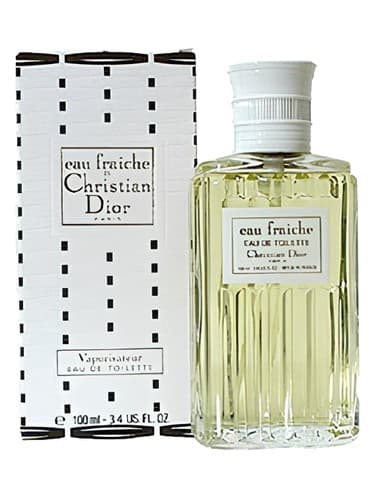
Dior introduced Eau Fraiche in 1952, a Chypre Floral women's fragrance crafted by Edmond Roudnitska. The composition opens with lemon, mandarin orange. A heart of palisander rosewood follows. The composition settles on a base of oakmoss, vanilla.
Fragrance Notes
Top Notes
First impression (15-30 min)
Middle Notes
Heart of the fragrance (2-4 hrs)
Accords
citrus
woody
mossy
earthy
sweet
When to Wear
Best Seasons
Time of Day
☀️Day36%
🌙Night5%
Where to Buy
This site contains affiliate links. As an Amazon Associate and partner of other retailers, we earn from qualifying purchases at no extra cost to you.
Community Review
Roudnitska's 1952 vintage chypre-cologne for Dior; progenitor of Eau Sauvage and Diorella, a masterclass in citrus-oakmoss balance now only available in vintage.
The Verdict
Dior Eau Fraîche occupies a peculiar and privileged position in the history of fine fragrance. Created by Edmond Roudnitska in 1952 — his second composition for the house — it predates Eau Sauvage (1967) and Diorella (1972), the fragrances that made his reputation. And yet Roudnitska himself acknowledged it as personally significant, and scholars of his work increasingly recognize it as the forgotten root of everything that came after.
In its original formulation — both as Eau Fraîche and the related Eau de Cologne Fraîche — this fragrance is now discontinued. What you can find are vintage bottles, decants from serious collectors, and the intellectual satisfaction of tracing the line from here to Eau Sauvage to Diorella. For anyone interested in where modern fine fragrance came from, Eau Fraîche is a primary text.
What It Smells Like
The opening is citrus in the classical sense: Lemon and Mandarin Orange done with the kind of naturalistic precision that has largely vanished from contemporary releases. One reviewer described finding "one of the most beautifully realistic lemon notes I've ever smelled, heightened further by verbena, countered by a divinely serene, creamy base." That single sentence captures the opening's distinctive quality — the citrus is real rather than synthetic, sharp but immediately balanced by the warmth rising from below.
In older bottles, a characteristic accord of "boozy and ripened melon" blooms in the early wear — a quality that fragrance historians identify as a Roudnitska signature, the same ripened, slightly fermented fruit note that distinguishes his work across decades. Palisander Rosewood in the heart adds a warm, slightly spiced woodiness that bridges the bright opening and the mossy base.
The base is Oakmoss and Vanilla — classic chypre materials handled with the master's characteristic restraint. The oakmoss here is not the heavy, dry-cleaning quality of some vintage chypres; it is sunlit, damp, and quiet. The vanilla-glazed mossiness keeps the fragrance grounded in something warm and skin-close rather than abstract. One reviewer called the overall drydown "fresh meeting flesh, the sweat of sunshine, a noble daytime chypre" — which is as precise and evocative a description as any formal review could offer.
When to Wear It
Despite its cologne-strength origins, Eau Fraîche performs better than you might expect. Multiple reviewers warn explicitly: "Do not be fooled by the word 'cologne' — it can perform at eau de toilette strength and last quite a long time." The vanilla and oakmoss base provides genuine longevity for the concentration.
Spring and summer are the obvious seasons — the citrus-mossy character is calibrated for warm weather and daylight. Casual daytime wear suits it best: a fragrance for the person who takes pleasure in the quality of a scent rather than its statement. Vintage bottles carry the authenticity of materials that simply cannot be replicated under current IFRA restrictions; oakmoss in particular is heavily regulated, and the vintage versions use it more liberally and naturally than any modern reconstruction could.
Longevity & Projection
Reports on longevity vary considerably depending on the age and condition of the bottle. In well-preserved vintage examples, reviewers report performance approaching six to eight hours — "a frail, fleeting thing? No — while it lasts, it's pure Roudnitska magic, and it lasts longer than the name suggests." In older or poorly stored bottles, the citrus top notes may have degraded, leaving primarily the base.
Sillage is inherently modest given the cologne concentration and the fragrance's character as a daytime, personal-space scent. It is not meant to fill rooms. It is meant to be discovered by proximity.
The Community Says
The conversation around Dior Eau Fraîche is primarily among dedicated fragrance historians and vintage collectors rather than casual wearers, which reflects both its discontinued status and its appeal to a specific type of enthusiast.
The sentiment is uniformly appreciative among those who have encountered it. One reviewer called it "an extraordinary classy, understated, long-lasting cologne built on a chypre base with a prodigiously tuned and deceptively simple citrus composition." Another noted that it "does not deserve the neglect it receives compared to Roudnitska's more famous Dior works — it is truly beautiful."
Community votes on Fragrantica show 43% loving it and 50% liking it — an exceptionally high positive rate that reflects both the self-selecting nature of the vintage enthusiast community and the genuine quality of the fragrance.
Who Should Buy This
Dior Eau Fraîche 1952 is, practically speaking, a fragrance for serious enthusiasts — collectors, historians, and those who derive satisfaction from encountering the origins of great perfumery. If you have worked through Eau Sauvage and Diorella and want to understand where Roudnitska began, this is the primary source.
For casual wearers, the discontinued status and vintage-market pricing make this a difficult recommendation. The fragrance is exceptional, but accessing it requires effort and luck.
The Bottom Line
An essential chapter in the history of French perfumery and a beautiful fragrance in its own right. Roudnitska's second Dior composition is simpler than his later masterpieces but shares their fundamental quality: a natural, sun-warmed brightness over an earthy, mossy base that smells like something encountered rather than manufactured. If you encounter a well-preserved vintage example, it is worth every effort to experience it.
Consensus Rating
8.6/10
Community Sentiment
positiveSources Analyzed
7 community posts (3 Reddit) (4 forum)
This review is based on analysis of 7 community discussions. Individual experiences may vary.